What moves human beings, and how one need affects another.
A patient who does not sleep, does not eat properly, is touched by no one, or lives with the alarm switched on has no fuel to learn, to work through, or to change, whatever the technique. This book shows how to read these needs, in what order to care for them, and what to do with each answer.
Alba arrives asking for a study technique. She reads the same page three times and retains nothing. Her map shows something else: a bedroom with no door, five hours of broken sleep, no corner of her own, and no conversation in which she can say what she feels. The lack of focus is the last step of a staircase that begins much earlier.
Every decompensated need decompensates another. This book shows the path the lack travels.
In the Fundamentos da Virtologia, caring for needs is one of the most important aspects of treatment. It is not preparation for the real work. It is the ground on which everything else rests.
“An individual who has no bond, no affection, no space of their own, no minimal control over their routine, no rest, no fun, has groups 1 and 2 completely wrecked. If I sit with this person and, for ten years, only interpret dreams and associations, without touching the management of these needs, I force this brain to try to evolve without fuel.”Dr. Eduardo Casarotto, Fundamentos da Virtologia
The rule fits in one sentence: a lack of a basic need is not interpreted, it is regulated. Each need that is met fills the tank a little. Each unmet need drains it. With a low tank, a person reads the world worse, reacts more, and learns less.
That is why the book opens with a thesis that holds for any line of work. CBT, psychoanalysis, systemic therapy, humanistic therapy, and analytical psychology work better when the needs are in balance. The therapist does not need to change approaches. They need to know how to look at the foundation before going deeper.
And the needs do not stand alone. Each virtue treats a need in excess and frees the ones that the vice kept in deficiency. It is through the needs that Virtology reaches the virtues.
From what a need is to Monday's session.
Virtology in a few pages, for those who come from another training. What a need is and what is only desire. The 0-to-10 scale. Needs and glia.
A complete profile for each, across the five groups: Primitive, Sensation and Connection, Development, Reconnection, and Transcendence.
Nine chapters on the network of the 51: where the lack flows, the excess that blocks, the mask, the nodes of the network, what addictions inflate, and the constellations.
The first conversation, regulating before interpreting, from needs to virtues, clinical conditions, the stages of life, any approach, record keeping, and follow-up.
You learn to read one profile and consult the other fifty the same way. Each need has, on average, almost six thousand words.
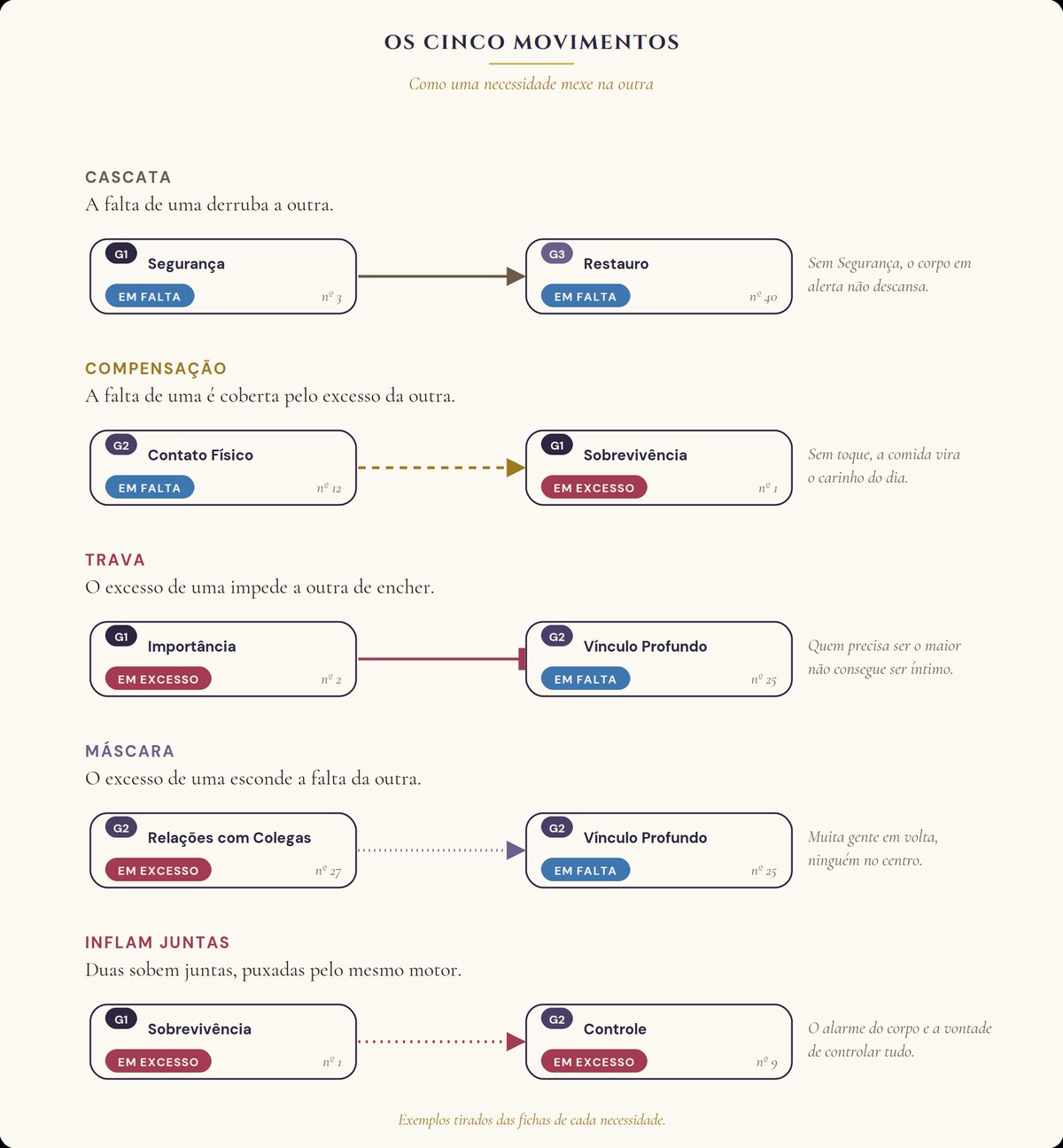
This is the part that changes how you read the case. It looks at all 51 at once and asks what happens to the others when one moves out of place.
One lack knocks down the next.
One need covers the lack of another, and the lack shows up there as excess.
The excess of one keeps the other from happening.
What is visible hides what is missing, and fools its own owner.
Two rise at the same time, pulled by the same alarm.
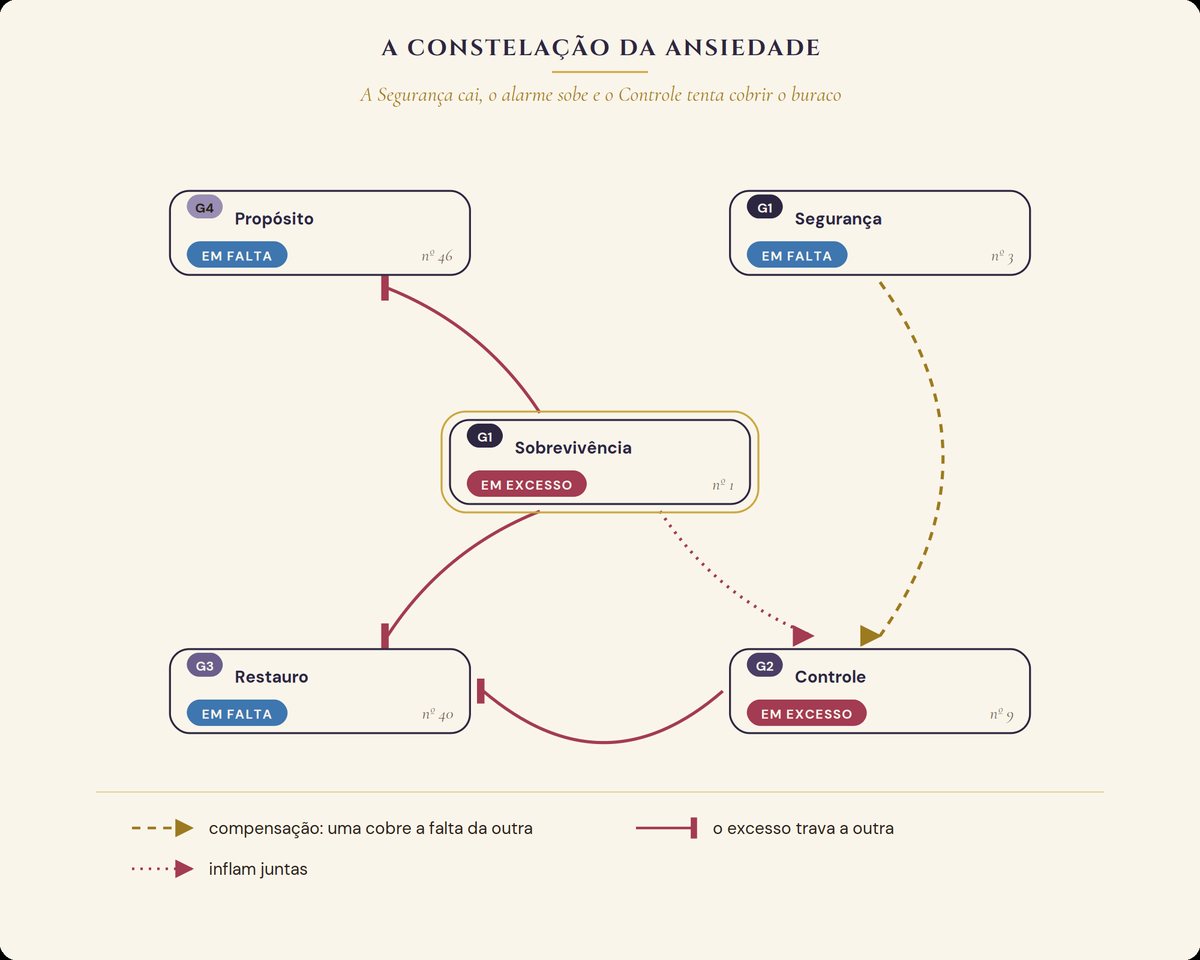
Each movement comes with “how it shows up in session” and “the misreading.” Then come the nodes of the network, the needs that trigger the most and the ones that receive the most, and nine constellations ready to recognize in the therapy room:
The Part closes with an eight-step guide to reading the whole map, with one case from beginning to end.
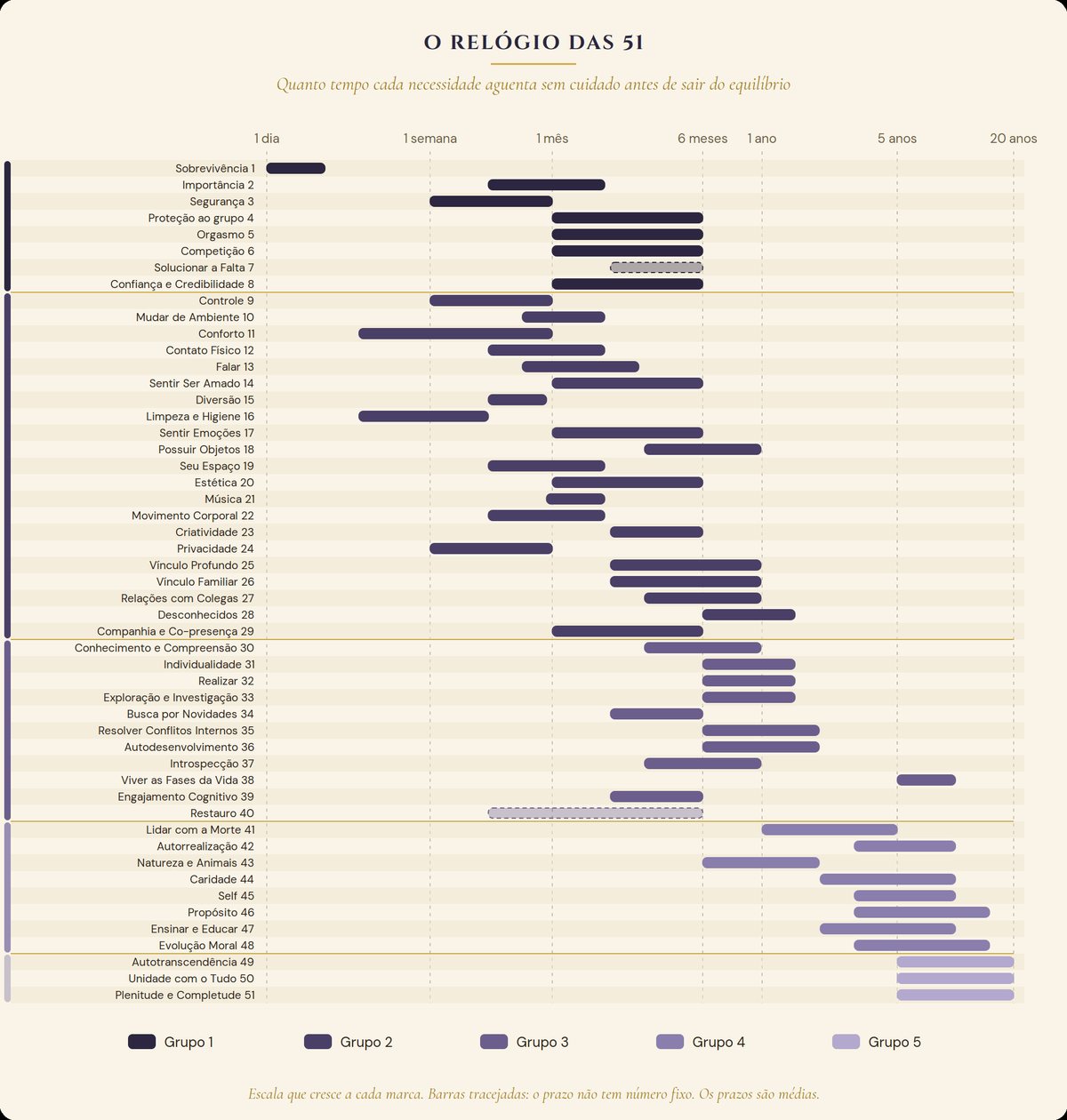
The book was designed to be consulted. The figures show what the text explains.


Seven chapters of clinical practice, with cases and with the most common mistakes.
Opening questions for each group, scoring through conversation, and what the person tells without noticing.
How to build a small, concrete regulation plan, and use each need's clock to schedule the reassessment.
The Pyramid, what comes before, the combination, and the leading virtue. Three common mistakes: virtue before the foundation, virtue alone, choosing by the complaint instead of by the map.
Anxiety, OCD, panic, depression, personality disorders, compulsions, and work-related syndrome. And the boundaries: the body, risk, what is cured and what is contained.
The group that pulls hardest at each age, the demand of the stage that is not a symptom, and the family, where needs are regulated or dysregulated.
Where the 51 help in CBT, psychoanalysis, systemic therapy, humanistic therapy, and analytical psychology. Each section states that the approach is not Virtology and respects both sides.
A record template, when to space out sessions and when to discharge, referral, and the ethics of the instrument.
The appendix with the whole map and the reference tables, to keep at hand during sessions.
Each chapter ends with its sources. Virtology comes with credit to Dr. Eduardo Casarotto. Outside authors are cited by name, with the work, and the book always says when a passage is not Virtology.
The Fundamentos da Virtologia are the source of everything here. They bring together all of Virtology. This book takes the fifty-one needs out of the whole and gives each one a place of its own.
The 51 profiles, the network of needs, the clinical part, the Map of the 51, and the reference tables. Yours forever, to open at whichever need the patient brings.
Not yet. The book is currently available only in Portuguese. An English translation is coming soon. The purchase on this page is for the Portuguese edition.
It is a PDF book with instant delivery. As soon as the purchase is confirmed by Hotmart, you receive access and can read it on your phone, tablet, or computer, and print it if you like. The table of contents is clickable, so you can go straight to the need you are looking for.
Yes. The book was written for therapists from any training. It opens by explaining Virtology in a few pages, and Part IV has an entire chapter on how to use the needs in CBT, psychoanalysis, systemic therapy, humanistic therapy, and analytical psychology, without changing your line of work.
Part I is worth reading first, because it gives the scale and the vocabulary. After that, the profiles can be opened at whichever need the patient brings. Part III, on the network, yields more after you have read a few profiles.
No. The Fundamentos, by Dr. Eduardo Casarotto, bring all of Virtology: the theory of personality, the virtues, the Laws of Life, the psychic apparatus, and clinical management. The 51 needs, the five groups, the 0-to-10 scale, the time frame of each need, the Developmental Bands, the virtues, the Pyramid, and the combinations are his. The Treatise gives the needs a place of their own and a language for reference.
The book includes the Map of the 51 as an appendix, the reference tables, and a record template. The map is an instrument for conversation in session, not a source of truth about the patient, and the book explains how to use it that way.
The 51 needs, the network between them, and the path to the session, in a single book.

The version of this book for the general public, with Euller Manoel.
Discover the book →
The Gospels and Virtology, side by side, with Euller Nascimento.
Discover the book →
Five layers to see the whole design of who you are.
Discover the Map →
The 84-day method to rebuild your course, virtue by virtue.
Discover the book →
The grammar of life, law by law.
Discover the book →
33 virtues in fables, myths, and parables.
Discover the book →
A book to hold you through grief for a beloved animal.
Discover the book →