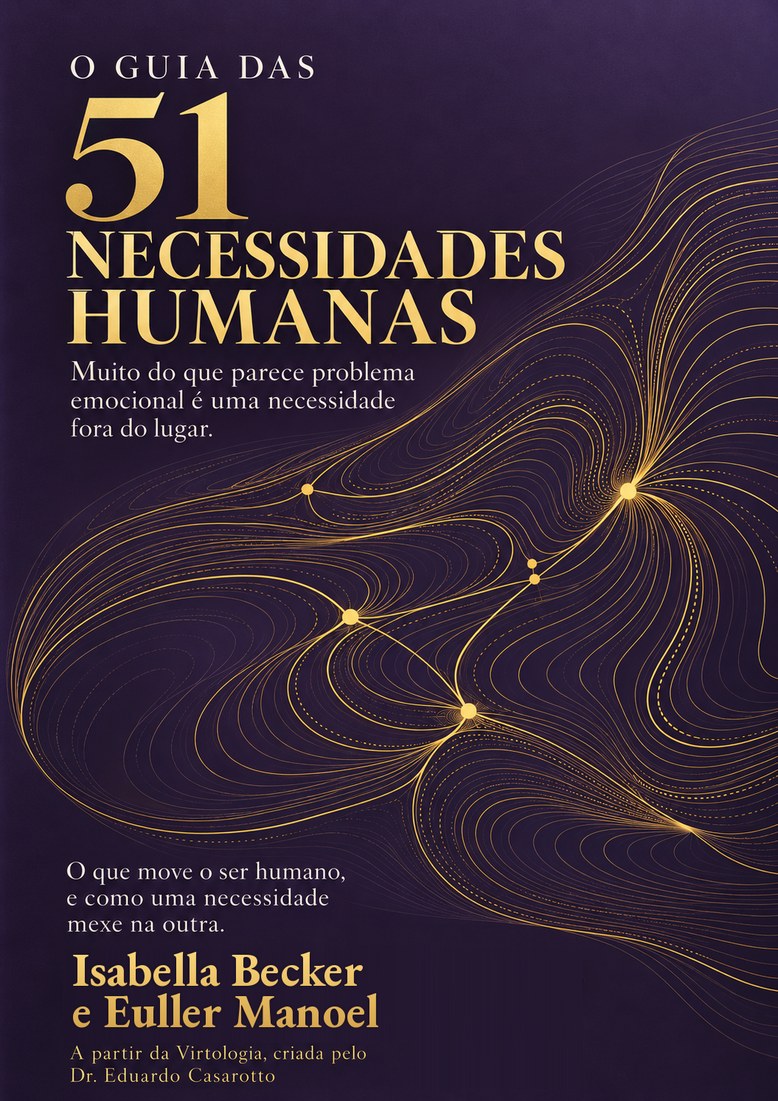
The neuroscience of the virtues and the message Christ came to deliver.
Pride and selfishness are not just character flaws. They are paths the brain has traveled so many times that they started running on their own. What Jesus taught with his own life can also become a path: love of neighbor, forgiveness, social justice, and the Kingdom of God, repeated until they become the natural way to react.
Wars with the name of God on the flag. Pulpits that preach against the neighbor. Families that cast out a child in the name of faith. And, at home, the same thing on a smaller scale: the person who knows what is right and, under pressure, does the opposite.
Knowing is not enough. What Christ taught is learned the way the brain learns everything it keeps: by repeating, until it becomes a response.
Two bodies of knowledge that had never been put together in this way.
“Virtue is not an idea to admire. It is an act to practice.”Euller Nascimento, in the book's Introduction
On one side, the words of Jesus, read with attention to the Greek and the Hebrew. On the other, Virtology, created by Dr. Eduardo Casarotto: the 33 virtues, the Pyramid of Virtues, the seven Developmental Bands, and the way pride and selfishness operate in the brain.
The thesis fits in one sentence. No one abandons an old path without opening a new one. Good intentions are not enough. What changes a person is the new response, repeated with awareness, until it is as natural as the old one was.
That is why the book does not end in reflection. It proposes training: one virtue at a time, starting with the Treatment Foundation, in fourteen-day cycles.
“If I then, your Lord and Master, have washed your feet; ye also ought to wash one another's feet.”
John 13:14This is what the book calls the neural structures of Christ.
Seeing the other as someone who matters as much as I do. The border between “us” and “them” dissolves.
Who was a neighbor? · Luke 10:36Letting go of the weight that ties you to the past, without denying what happened. Whoever keeps count is still collecting.
Seventy times seven · Matt. 18:22Love that shows up as action in the face of the pain and inequality of the person beside you.
To preach the gospel to the poor · Luke 4:18The state in which the separation between me and the other ceases to exist. It begins within and shows up without.
Within you, among you · Luke 17:21First the person. Then the world. 146 chapters in 32 parts.
The structure inside each one of us: the root, Scripture, and training.
The structure in society and in history: from the micro to the macro.
The border between “us” and “them” needs only one line.
What pride and selfishness do when they pass from the person to the group. And the way back, with the virtues each situation calls for, in order.
Book II deals with painful subjects. It was written to be read after the first. Without the foundation of Book I, the criticism sounds like an accusation against others. With that foundation, it becomes a mirror.
The scene does not say that places do not matter. It says that no place owns God.
On John 4:21–23The Gospel quoted accurately. Virtology without dilution.
Every chapter rests on what the Gospels say, with book, chapter, and verse, so you can check them in your own Bible.
What the Greek and the Hebrew say and the translation hides. Metánoia is not remorse: it is a change of mind.
What happens inside the person living the scene: the defense, the need, the Developmental Band.
Each situation with the combination of virtues that works on it, always with the ones that come before. No virtue comes alone.
Where did my pride and my selfishness defeat me? When did I follow the neural structures of Christ? It is worth answering in writing.
One virtue, one concrete situation in your life, fourteen days. First the Treatment Foundation, beginning with Humility.
Bringing two things together requires saying what comes from where.
Book I and Book II, the four pillars, thirteen psalms, the parables, the ten scenes, and the fourteen-day training. Yours forever, to come back to whenever you need it.
Not yet. The book is currently available only in Portuguese. An English translation is coming soon. The purchase on this page is for the Portuguese edition.
It is a PDF ebook with instant delivery. As soon as Hotmart confirms the purchase, you receive access and can read it on your phone, tablet, or computer, and print it if you like.
No. The book was also written for those who have no faith and distrust the Gospel. It reads what Jesus taught as conduct that can be trained, and it quotes the biblical text with references so you can check.
No. It does not speak on behalf of any church or any tradition. It quotes the Gospels accurately and separates what is biblical text, what is Virtology, and what is the authors' reading.
Book I is worth reading first, because it builds the foundation: pride, selfishness, the four pillars, and the training. Book II can be read by whichever subject catches your attention most.
No. The book explains whatever is needed, in simple language, and says what is scientific consensus and what is a proposal of Virtology.
No. It helps you understand and train the virtues, but it does not replace the care of a doctor or a therapist.
It is the system created by Dr. Eduardo Casarotto, which brings together the 33 virtues, the Developmental Bands, the human needs, and the Laws of Life. This book places Virtology beside the Gospels.
The Gospels and Virtology, side by side, from the individual to society.

Five layers to see the whole design of who you are.
Discover the Map →
The grammar of life, law by law.
Discover the book →
The 51 needs for everyone, with Euller Manoel.
Discover the book →
33 virtues in fables, myths, and parables.
Discover the book →
A book to hold you through grief for a beloved animal.
Discover the book →